AI-powered delivery date estimates to boost conversion

Give shoppers peace of mind and protect and grow your bottom line

Personalized tracking experiences to build brand loyalty

Returns and exchanges management to mitigate fraud and reward best customers

Proactive communication to drive customer lifetime value

Delivery claim management to tackle fraud and build trust




Post-purchase Has Plenty of Data. Now What?

See how IRIS™ interprets post-purchase complexity in real time.
Key takeaways
- IRIS™ is Narvar's intelligence layer, utilizing machine learning, analytics, and retail expertise to transform over 74 billion interactions into insights.
- Trusted by 1500+ brands and interacting with 90%+ of U.S. online adults, IRIS™ helps retailers personalize, optimize, and protect post-purchase experiences by analyzing data to provide predictive, actionable insights.
- It aids in risk assessment, fraud management, and operational efficiency, integrating signals from various stages of the post-purchase journey to detect patterns and guide decision-making.
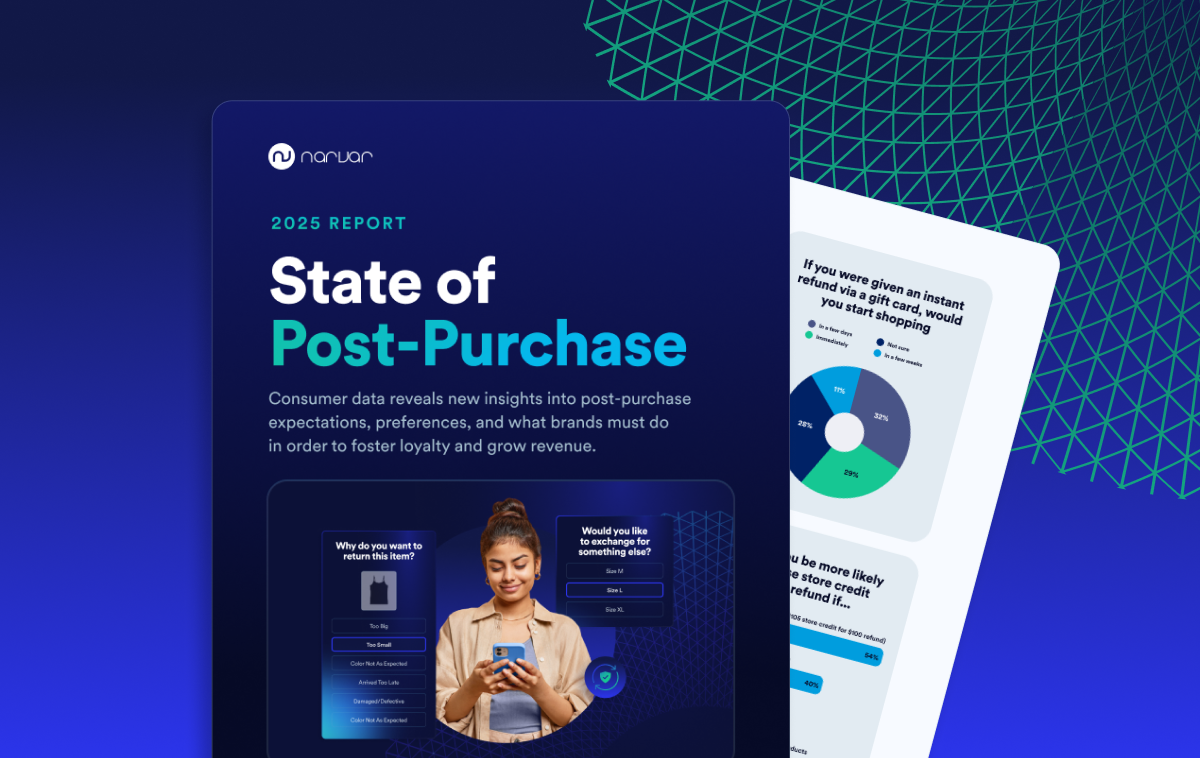
Learn What Consumers Want Beyond Buy
In our 2025 State of Post-Purchase Report, we explore what reassures, delights, and re-engages shoppers — and how retailers can create experiences that drive revenue and loyalty.
The post-purchase world has never been more complex. Every order triggers an endless trail of pings, scans, timestamps, routing codes, exceptions, and shopper check-ins — a constant flow of signals retailers are expected to make sense of in real time.
But despite all this information, critical questions too often remain unanswered: Is this package actually moving? Will this delivery arrive on time? Is this return normal or suspicious? Is this shopper losing trust — and why?
Retail doesn’t have a visibility problem anymore. It has an interpretation problem.
That gap — the space between what’s happening and what it means — is now one of the biggest risks (and opportunities) in the post-purchase experience.
This is the world IRIS™ was built to address.
IRIS™: Narvar’s Intelligent Retail Insight Service
IRIS™ is Narvar’s intelligence layer — a neural network of machine learning, analytics, and retail domain expertise that powers every product across the platform. It transforms more than 74 billion interactions into insights that help retailers personalize, optimize, and protect every post-purchase experience. As the creator of the post-purchase experience, our platform is trusted by 1500+ of the world’s most admired brands, interacts with 90%+ of U.S. online adults, and touches 2 billion+ packages each year, powering IRIS with the richest, most comprehensive data sets around.
IRIS analyzes these interactions to surface predictive, actionable insights that help merchants better assess risk and trust signals. These insights inform smarter, context-aware decisioning in post‑purchase workflows such as claims and fraud management, helping reduce abuse, streamline operations, and enhance experiences for legitimate customers.
IRIS is the connective tissue that makes post-purchase data meaningful, actionable, and — in time — autonomous. Today, IRIS powers more accurate predictions, smarter workflows, and predictive, actionable insights to help you make better decisions.
IRIS is the connective tissue that makes post-purchase data meaningful, actionable, and — in time — autonomous.
And as the industry enters a new chapter where post-purchase processes need to make intelligent, independent decisions, IRIS is the foundation to enable this level of autonomy.
Why retail needs an intelligence layer now
For the last decade, retailers optimized for speed: faster shipping, faster refunds, faster everything. But this focus on speed alone, without the intelligence to manage risk, complexity, and accuracy only created more stress on a compressed timeline.
Today’s post-purchase landscape is shaped by forces retailers can’t control:
- Carrier variability
- Climate-driven disruptions
- Rising fraud
- Soaring consumer expectations for transparency
- The shift toward margin protection during exchanges and returns
With so much outside a retailer’s control, the future of post-purchase can’t rely solely on faster execution. The future of post-purchase requires systems that can detect patterns, surface risks, and provide insights at the appropriate times to guide more accurate decision-making.
IRIS is aligned with where the industry is already going: from simply reacting to issues toward proactive, insight-driven post-purchase experiences.
How IRIS™ works: Seeing + understanding + guiding action
Most post-purchase systems report what has already happened. IRIS™ goes further by surfacing patterns and risks across orders, returns, and claims, giving retailers actionable insights to guide decisions and focus attention where it matters most.
IRIS sees
IRIS ingests signals from every part of the post-purchase journey: carrier scans, delivery patterns, shopper behavior, historical data, anomaly signatures, transit risk. Not as isolated datapoints, but as interconnected patterns that influence one another.
Every scan, every pause, every deviation carries meaning. IRIS reads these signals the way a seasoned operator would: not as a static feed of updates, but as a story unfolding in real time. A routing change might signal the beginning of a delay. A minor exception at one hub might foreshadow a bottleneck forming further down the chain.
The future of post-purchase requires systems that can detect patterns, surface risks, and provide insights at the appropriate times to guide more accurate decision-making.
IRIS detects the early signs of friction, like the slight drift that precedes a missed delivery window or the small anomaly that could quietly morph into a cascade of support tickets if overlooked. These moments are often invisible to traditional systems because they occur in the space between updates, where meaning emerges before metrics catch up.
But seeing early signs of friction is only the beginning. Retailers don’t just need to know what might happen: They need to understand why it’s happening and what it implies. That’s where the next layer of intelligence comes in.
IRIS understands
Seeing patterns is powerful, but understanding their significance is what transforms data into intelligence. IRIS interprets the signals it sees through models trained on billions of post-purchase events — models that understand not only what has happened, but what those patterns have historically led to under similar conditions.
But IRIS doesn’t stop at prediction. It interprets context — the nuance that determines whether a risk is minor or meaningful. IRIS helps you connect behavior data to identity data to help make the determination of how best to proceed with anomalous activity.
Retailers don’t just need to know what might happen: They need to understand why it’s happening and what it implies.
For example, if a shopper is exhibiting uncharacteristic behavior and they're a VIP, you can proactively reach out to offer support. However, if IRIS recognizes a pattern of fraudulent activity from a shopper, you can be warned to look out for a questionable return. By understanding how risk, behavior, history, and operational constraints intersect, IRIS gives retailers something they’ve never truly had: a clear grasp of what’s happening, why, and a recommendation for what you should do next. That’s where IRIS shifts from insight to impact.
IRIS guides action
Understanding is only meaningful when it informs what happens next. IRIS acts as the intelligence layer that elevates human judgment and strengthens the workflows retailers already rely on.
IRIS guides action in three essential ways:
1. Surfacing insights at the right time
IRIS highlights risks like anomaly patterns and negative signals before they become costly or visible to the shopper. Teams can intervene when action still matters.
2. Informing next-best steps
IRIS detects behavioral patterns and anomalies across delivery claims, returns, and protection workflows to assess risk, inform automated decisions, and improve accuracy over time. The decisions remain human-guided or workflow-driven, but they are far more precise because IRIS sharpens the understanding behind them and recommends actions to take.
3. Strengthening automation with intelligence
IRIS feeds Narvar’s existing workflows with smarter signals. Instead of reacting to simple conditions, automation can be driven by predicted outcomes, patterns, and context. As retailers act on these insights, IRIS continues learning — refining models, sharpening predictions, and paving the path toward more advanced capabilities in the future.
This is the architecture autonomous agents will depend on.
What makes IRIS™ different
IRIS is not a general-purpose AI model repurposed for retail. It is a retail-native intelligence layer trained on:
- a decade of proprietary Narvar data
- billions of global post-purchase events
- shopper behavior patterns across industries
- carrier performance at scale
- deep understanding of operational workflows
Where many AI tools are descriptive (“Here’s what happened”), IRIS is interpretive and predictive (“Here’s what this means and what we recommend you do”). Most importantly, IRIS was built specifically for the retail industry, making it much more useful to retailers than other more general intelligence solutions.
Today, IRIS helps teams act earlier and more precisely. Tomorrow, it will help systems act more independently.
IRIS™ as the foundation for agentic AI
The evolution of retail intelligence doesn’t happen in a single leap. It unfolds the way all meaningful transformations do: quietly at first, in the subtle shift from information to understanding, from reaction to anticipation, from fragmented signals to coherent insight.
Agentic AI represents a future where post-purchase systems don’t just record what happened — they interpret intent, foresee disruption, and help shape the experience itself. It is a world where the technology behind the scenes becomes an active participant in delivering trust.
Agentic AI represents a future where post-purchase systems don’t just record what happened — they interpret intent, foresee disruption, and help shape the experience itself.
Before a system can act with confidence, it must learn to see with clarity. Before it can operate with independence, it must understand the nuances. And before it can improve on its own, it must recognize patterns, context, and consequences.
IRIS provides these essential ingredients for the future of post-purchase:
- the ability to read meaning in motion
- the foresight to recognize what’s taking shape before it fully forms
- the context needed to distinguish true risk from ordinary noise
- the learning loops that strengthen insight over time
- the deep domain understanding that grounds intelligence in the realities of retail
These are not optional features of an agentic future. They are the preconditions.
With every signal it interprets and every pattern it refines, IRIS is building the scaffolding for what comes next — a post-purchase experience that can support itself, right itself, and even improve itself.
The road ahead: What post-purchase will become
The post-purchase journey is drifting toward a different kind of future — one where intelligence quietly steadies the moments that once felt uncertain.
As retail grows more intricate and the emotional stakes of every delivery rise, IRIS is evolving in parallel. Each signal it interprets, each pattern it learns, adds a new layer of understanding. Over time, its vision sharpens. Its predictions deepen. Its presence expands.
The future of post-purchase won’t be shaped by dashboards or teams scrambling to connect dots in the dark. It will be shaped by systems that can sense the subtle movements before they become disruptions. The post-purchase journey has always held more complexity than most systems were designed to manage — and more opportunity than most teams have had the insight to act on.
IRIS brings something new to that reality: a way to read meaning in the signals, to understand the patterns beneath the surface, and to illuminate the path forward with greater confidence. It doesn’t replace judgment or take over decisions, but it gives retailers the intelligence they need to move through uncertainty with far more insight — and with far less strain. In a world defined by complexity, IRIS offers what the post-purchase experience has always needed most: a clearer view of what’s unfolding.

See How to Intelligently Power Every Moment Beyond Buy
IRISTM empowers retailers to engage customers, streamline operations, and drive profitable growth through intelligent personalization.

Frequently asked questions (FAQs)
What is IRIS™ and what does it do?
IRIS™ is Narvar’s intelligence layer, a neural network of machine learning, analytics, and retail expertise. It transforms interactions into insights to help retailers personalize, optimize, and protect every post-purchase experience.
How does IRIS™ help retailers manage post-purchase complexity?
IRIS™ analyzes interactions to surface predictive, actionable insights. These insights help merchants assess risk and trust signals, reduce abuse, streamline operations, and enhance customer experiences.
What makes IRIS™ different from other AI models?
IRIS™ is a retail-native intelligence layer trained on proprietary Narvar data, billions of global post-purchase events, and deep operational workflows. It is interpretive and predictive, specifically designed for the retail industry.
How does IRIS™ improve post-purchase decision-making?
IRIS™ sees patterns and risks, understands their significance, and guides actions. It surfaces insights at the right time, informs next-best steps, and strengthens automation, enabling more accurate and proactive decision-making.
Related posts