AI-powered delivery date estimates to boost conversion

Give shoppers peace of mind and protect and grow your bottom line

Personalized tracking experiences to build brand loyalty

Returns and exchanges management to mitigate fraud and reward best customers

Proactive communication to drive customer lifetime value

Delivery claim management to tackle fraud and build trust




Turning the Page on Ecommerce Returns: From Refunds to Revenue

Navigate the post-purchase journey with smarter returns policies that protect margins and delight shoppers.
Key takeaways
- In 2025, U.S. consumers returned an estimated $850 billion in merchandise, making returns a pivotal factor in retail success.
- Optimizing returns and exchanges is crucial for reducing negative impacts and driving repeat purchases.
- Offering store credit and easy exchanges can improve customer satisfaction and reduce friction.
- Encouraging exchanges over refunds can mitigate losses from restocking and markdowns.
- Implementing flexible return locations and fast replacements can enhance consumer experience.
- Using AI-powered systems to flag suspicious activities can protect margins and maintain trust with legitimate shoppers.

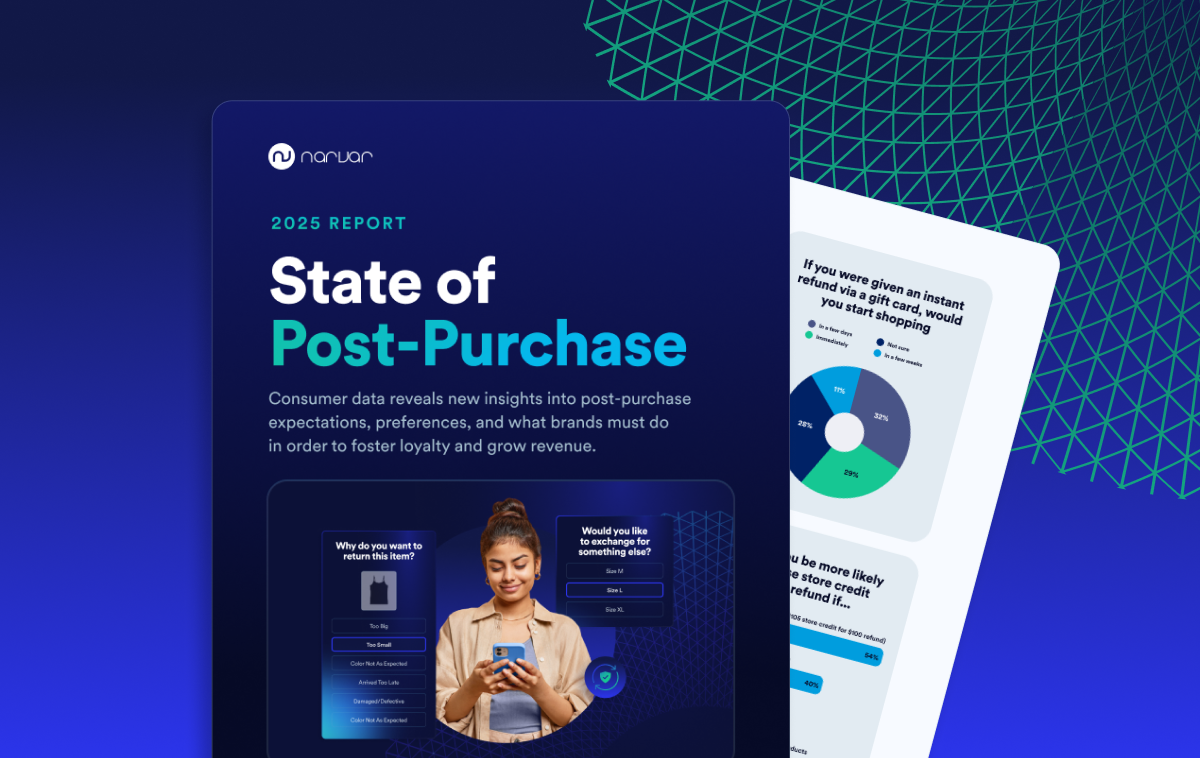
Learn What Gives Consumers Peace of Mind Beyond Buy
In our 2025 State of Post-Purchase Report, we explore what reassures, delights, and re-engages consumers — and how retailers can create experiences that drive revenue and loyalty.
You open the box. It’s not quite what you expected. Maybe the color is off. Maybe the fit is weird.
Do you:
- Sigh, shove it in the closet, and vow never to shop here again?
- Attempt an exchange, crossing your fingers for a better fit?
- Brave the returns process and hope for a quick refund?
Or do you take the fourth path — where the retailer makes it effortless to exchange, return, or keep the item with confidence?
For retailers, that “what happens next” moment is worth billions. In 2025, U.S. consumers will return an estimated $850 billion in merchandise, which represents 15.8 percent of total retail sales. Any of those transactions can be a loss or a win. It’s up to you.
Returns have evolved from a cost center to one of the most powerful determinants of loyalty, margin protection, and brand trust. The difference between losing a consumer and keeping a shopper for life comes down to what happens after the box arrives.
And shoppers aren’t the only ones deciding what to do next. Returns are the retailer’s own Choose-Your-Own Adventure: Will you let returns derail margins and turn away shoppers or will you alter the path of your brand’s story toward a loyalty-building, revenue-retaining journey?
Chapter 1: The fork in the road
You are a retailer with a choice: You must protect margins while also ensuring a high-quality shopper experience. The way you handle returns and exchanges can impact both.
Returns are growing faster than sales across retail sectors. With online purchases being returned at a rate of 24.5%, the cost to process and restock these items — often discounted or unsellable — continues to erode profit margins. The logistics, labor, and inventory costs alone for handling an online return average 21% of the order’s value.
What was once considered a cost of doing business has become rocky terrain retailers must climb with care. In a recent survey, 66% of retailers told Narvar that returns pose a serious threat to profitability, and processing can cost anywhere from 20 – 65% of an item’s original value.
Consider this: 76% of consumers say a negative returns experience impacts the likelihood of buying from a retailer again. A poor returns and exchange process affects more than just a single sale - it impacts future sales as well. The ease of returns can drive repeat purchases while friction can turn off consumers.
With so much at stake, optimizing returns and encouraging exchanges to save the sale are no longer just “nice to have.” They are margin-critical priorities that reduce the negative impact of returns.
If you choose to guide shoppers with clarity instead of guesswork, continue your journey with the treasure map.
Chapter 2: The treasure map
Your returns and exchanges policy serves as a map for your shoppers to reclaim value. A good policy offers clear routes, fair checkpoints, and maybe even a few shortcuts. A bad one? That’s a maze of confusion guarded by dragons named “Restocking Fee” and “No Returns After 14 Days.”
If you opt for the latter returns policy choice, the journey may be fraught with challenges. The consumer may have to make a phone call to your service center, then figure out where to drop off the product for return, then wait for the new product and hope it’s what they’re looking for. This increases customer service calls and creates friction for the consumer.
But the waiting is the hardest part - 26% of consumers told Narvar the worst part of returning an online purchase is waiting for a refund.
Retailers can take advantage of this need for speed by encouraging consumers to take the path toward store credit. In fact, 29% of consumers would prefer to receive a refund instantly in the form of store credit for no fee.
Consider how a well-timed, intuitive exchange flow that leads shoppers toward a proverbial “treasure chest” might look...
A consumer goes to your website with the intent to return an item but is presented with the option to choose between refund, replacement, or store credit. In just a few clicks, the consumer can opt to replace the item with a different size or exchange the item for something similar. The end result: treasure secured. Crisis averted.
By implementing a consumer-facing return portal in which consumers can select the option that works best for them, retailers make exchanges the path of least resistance. And that’s what consumers want: 69% of consumers have wished it were easier to exchange an online order in the past year.
If you’re ready to discover the secret routes that turn returns into exchanges, venture next into the hidden passage.
Chapter 3: The hidden passage
Every adventurer dreams of finding a shortcut — a hidden passage that turns a difficult trek into a rewarding discovery. In retail, that hidden passage lies in the path between return and exchange.
A return may feel like the right choice for a consumer, but for retailers, it often means a detour through costly terrain: restocking, markdowns, and logistics expenses that can erode even the best margins. Only about 30% of returned merchandise can be resold at full price. The rest is often discounted or liquidated, further eating away at margins.
A secret passage forward? Encouraging exchanges instead of refunds. By reimagining operations and logistics, retailers can make it easier for shoppers to opt for an exchange over a return. That means simplifying how items are shipped, offering flexible return locations, and ensuring replacements are available and fast to deliver.
British menswear retailer Moss found this very passage. Confronted with high return rates due to fit and size, they opened the door to a smarter route: inviting online shoppers to visit one of their 110+ brick-and-mortar stores to exchange items instead of simply returning. This move to “Buy Online, Return in Store” (BORIS) improved consumer experience and kept more sales within reach. Their rate of omnichannel returns rose from 35% to 55%, turning potential losses into renewed loyalty and higher retention.
When retailers design policies and operations around exchange-first thinking, they don’t just patch over a problem. They uncover the path to profit, satisfaction, and stronger relationships.
Another route is to offer “keep the item” policies, where a refund is issued, but the shopper is allowed to keep or discard the item. It can be an efficient shortcut, saving on shipping, warehousing, and restocking costs while sparing shoppers an unnecessary inconvenience. Sometimes the choice can pay off: The consumer may end up enjoying the product after all or re-gift it to someone else.
As with any secret passage, “keep the item” policies come with risks. Shoppers may learn how to take advantage of the policy, turning convenience into an opportunity for abuse. That’s why many retailers are turning to AI-powered systems to flag serial returners and identify when this shortcut is being used in good faith or when it’s becoming a loophole.
If you want to uncover other dangers lurking beneath the surface, step cautiously toward the trap door.
Chapter 4: The trap door
As a retailer, you’re often presented with the task of distinguishing between a real consumer making a return versus a fraudster exploiting returns experiences. This is a tall order as roughly one-third of consumers admit to committing some form of retail fraud or abuse at least once in their lifetime.
For retailers, return fraud and abuse are the trap doors hidden beneath what should be a fair and honest path. They might start as small cracks — a shopper tries “wardrobing” by purchasing an outfit for a one-time event and then returns it, for example — but when too many go unnoticed, the floor gives way. Retailers fall into losses, strained margins, and broken trust with legitimate shoppers who may get ensnared in stricter blanket policies.
Unfortunately, return fraud is rampant in the retail industry. According to NRF, 9% of all returns are fraudulent. From decoy returns of counterfeit items, returning an empty box, and “bracketing,” fraudsters seem to use every trick in the book.
While fraudulent post-purchase activities aren’t the norm, they prove costly: return fraud cost retailers $103 billion in 2024 and some retailers reported spending as much as $70 just to investigate a single claim.
Avoiding those trap doors takes vigilance, strong policies, and the right tools to spot weak spots before anyone slips through.
Having a returns management system that offers the ability to flag suspicious return activity based on order history, return frequency, and product condition checks helps protect retailers while still offering a positive experience for legitimate shoppers.
If you seek a smarter, safer path through the returns adventure, read on to find the happy ending.
Chapter 5: The happy ending
Every return tells a story. And with the right tools, you can rewrite the ending.
Give shoppers confidence with a clear, seamless returns policy. Encourage exchanges or store credit as a viable option to retain revenue. Suss out bad actors to protect relationships with loyal shoppers.
In the end, the returns and exchanges path you create becomes the journey your shoppers remember. And when retailers design the smartest path forward with transparency, flexibility, and smart protection, the story always has a happy ending.
Congratulations! You’ve reached the end of your returns adventure and earned the ultimate reward: loyal shoppers who trust the journey.
The End

Learn how to deliver loyalty and protect margin post-purchase.
Narvar Shield unlocks revenue protection, revenue retention, revenue growth, and operational efficiencies.

Frequently asked questions (FAQs)
What is the estimated value of merchandise returned in 2025?
In 2025, U.S. consumers were expected to return merchandise worth $850 billion, representing 15.8% of total retail sales.
How can retailers turn returns into a positive experience?
Retailers can create a positive experience by making returns effortless, offering exchanges, refunds, or store credit options, and ensuring a smooth process to retain customer loyalty.
What impact do returns have on retailer margins?
Returns can significantly erode profit margins due to processing, restocking, and logistics costs, which average 21% of an order's value and can cost 20 - 65% of an item's original value.
What is a "keep the item" policy and its benefits?
A "keep the item" policy allows shoppers to keep or discard the item while receiving a refund, saving on shipping and restocking costs, and potentially increasing customer satisfaction.
Related posts