AI-powered delivery date estimates to boost conversion

Give shoppers peace of mind and protect and grow your bottom line

Personalized tracking experiences to build brand loyalty

Returns and exchanges management to mitigate fraud and reward best customers

Proactive communication to drive customer lifetime value

Delivery claim management to tackle fraud and build trust




How Harry Rosen Drove 13% Conversion Lift with Intelligent Estimated Delivery Dates
See what happened when a luxury retailer replaced static delivery estimates with AI-powered EDDs.
Key takeaways
- The challenge: Harry Rosen required a smarter, integrated solution for accurate delivery predictions, which was achieved using Narvar Promise, an AI-powered estimated delivery date solution.
- Results: A/B testing revealed over 90% accuracy in delivery predictions and a 13 percentage point lift in conversion rates, leading to increased revenue.
- Internal benefits: Improved visibility and adjustment capabilities for internal teams handling fulfillment complexities.
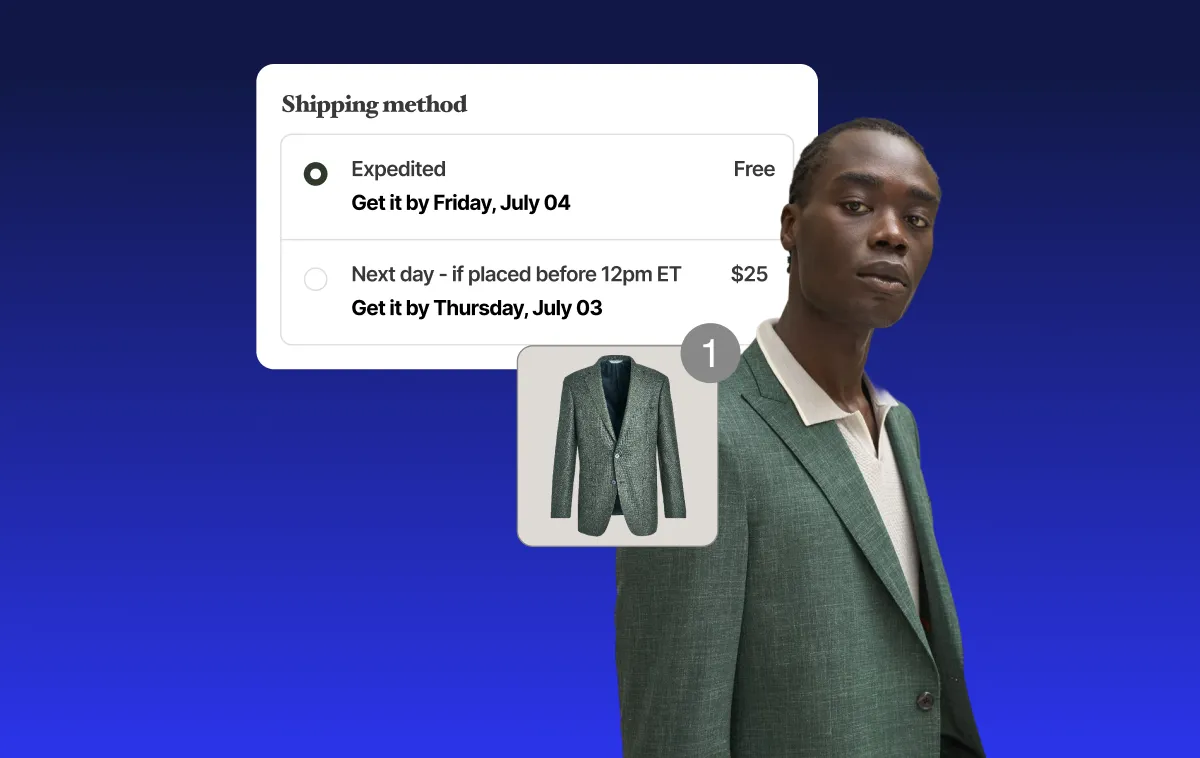
Promise When You Deliver, Deliver When You Promise.
Learn how brands are using AI-powered EDDs to drive more checkouts and fewer claims.
We’ve all been there: staring at the checkout page, wondering if that birthday gift will make it in time. And during peak season, estimated delivery dates become even more critical, especially for that one procrastinator in every family.
When Harry Rosen, a Canadian luxury retailer of designer menswear, took the guesswork out of delivery, the impact was clear: more confident customers and higher conversion rates.
With a mission to “empower every man to look and feel his best on every occasion,” the company understands time is of the essence when you need a new jacket for a big interview or swim trunks for a last-minute tropical vacation in winter.
And that means ensuring the best overall delivery experience - starting with estimated delivery dates.
Understanding estimated delivery dates in ecommerce
Estimated delivery dates (EDDs) can make or break a shopper’s decision to buy, with 45% of consumers saying they’re more likely to buy a product when they see an EDD at checkout. While speed has typically been a primary measure for success, shoppers increasingly care about reliability when it comes to shipping expectations.
In fact, 90% of consumers are willing to wait up to three days for an order, as long as they know exactly when it will arrive, especially if it means paying less in shipping fees.
With rising ad costs, increased competition, and a challenging economic environment, Harry Rosen wanted to provide a more transparent customer experience and increase conversion rate on their site. One area that could move the needle on both goals was optimizing their EDDs.
Previously, Harry Rosen used static ranges for estimated delivery dates. This approach sometimes resulted in packages arriving much earlier than anticipated and, in other cases, arriving late. This caused an increase in WISMO calls from disgruntled shoppers.

As a luxury brand, the company offers a high-touch experience, which means clearly communicating early and often. But it was sometimes tricky to proactively reach out about shipping disruptions when working with carriers that ship to locations outside of urban hubs in Canada.
“When it comes to the carrier, you can control a lot up to a certain point, but things are a bit out of your hands, even though it impacts your customer’s experience,” said Vanessa Marko, Sr. Director, Ecommerce, at Harry Rosen.
So many factors can impact a reliable estimated delivery date. Delivery disruptions can range from weather events to delivery location to postal strikes. An ice storm or a remote delivery location can add time to the delivery process. Additionally, the recent Canada Post strike and subsequent rotating local strikes are causing ripple effects across the entire country and industry.
Add in the complexity of fulfillment models like shipping from distribution centers, warehouses, and stores - or a combination in Harry Rosen’s case - and it can be challenging to pin down an accurate EDD.
How Harry Rosen improves EDD accuracy with Narvar
From the shopper’s perspective, delivery transparency throughout the consumer journey increases their likelihood to click ‘buy’ again and again:
- 75% of consumers are positively influenced by seeing EDDs
- 45% of consumers abandon a purchase if they have delivery concerns
- 24% of consumers cite lack of EDD as abandonment reason

What’s more, providing EDDs can impact multiple internal teams. Providing an accurate date (and sticking to it) can be tough to manage, so there were initial concerns about successful execution from internal stakeholders on Harry Rosen’s operations, logistics, and customer success teams.
"We needed a solution that was smarter and more integrated, but building something in-house would be challenging and time-consuming for the team," Vanessa said.
The luxury retailer already used Narvar products, so adding Promise to its suite of Shield, Notify, and Track made sense.
Promise is an AI-powered solution that offers a unique and personalized EDD for every order. Driven by machine learning models that continuously learn on origin, fulfillment duration, carrier service level, and time in transit, Promise allows retailers to predict the most accurate EDD for a given order. It takes into account historical and real-time data, as well as factors such as shopper location, what’s in their cart, and where the order is likely to be fulfilled and shipped from.
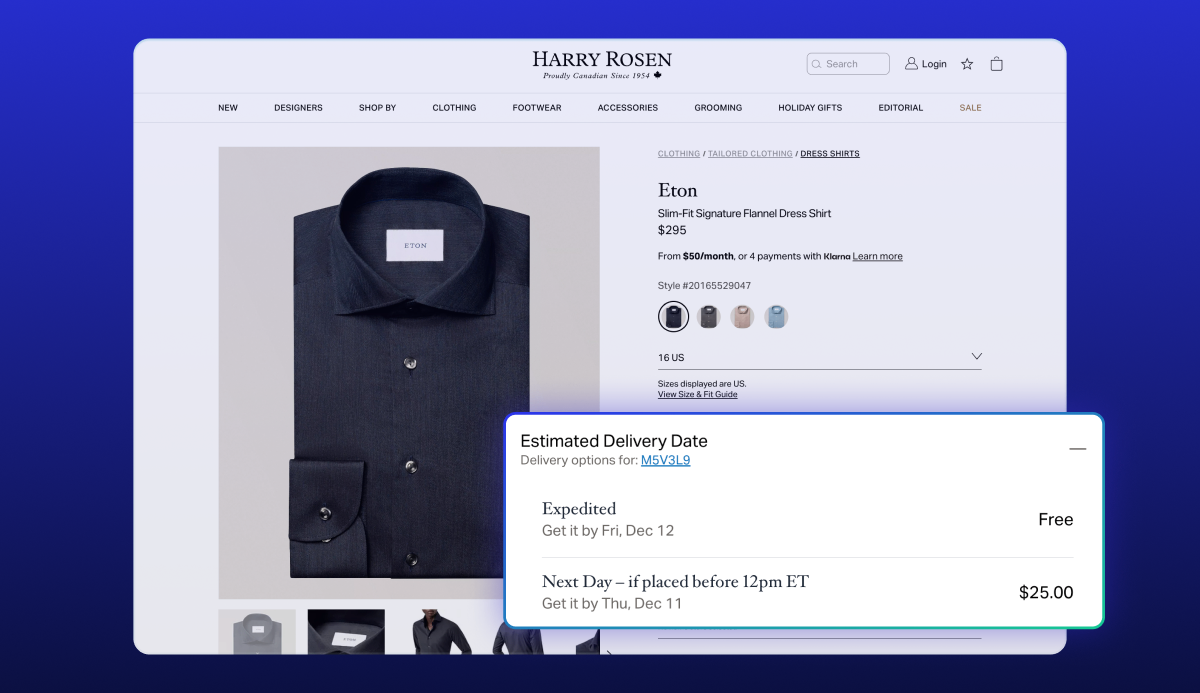
Promise also enables easy exception handling to accommodate special circumstances. For example, if there’s a flood that shuts down a warehouse, Promise allows retailers to easily build in short-term buffers to ensure they’re not overpromising on delivery dates when fulfillment or logistics slow-downs impact the time it takes for delivery.
As part of their implementation, Harry Rosen worked with Narvar to run an A/B test on their site to understand the true impact of showing Promise-powered EDDs versus static ranges. This allowed them to establish a baseline for key metrics like conversion rate and easily track how much additional revenue they were able to capture when Promise was enabled. In addition, Harry Rosen was also able to achieve over 90% accuracy.
Elevating estimated package delivery dates with Promise
Beyond boosting accuracy, Harry Rosen saw a huge lift in conversion rates by displaying EDDs on product detail pages (PDPs) and at checkout. They’ve also achieved double-digit increases for checkout conversion on both harryrosen.com and its off-price website FinalCut.
“A double-digit increase in conversion rates is a huge revenue win across both brands,” Vanessa said. “It goes a long way to continue to drive clients through the funnel.”
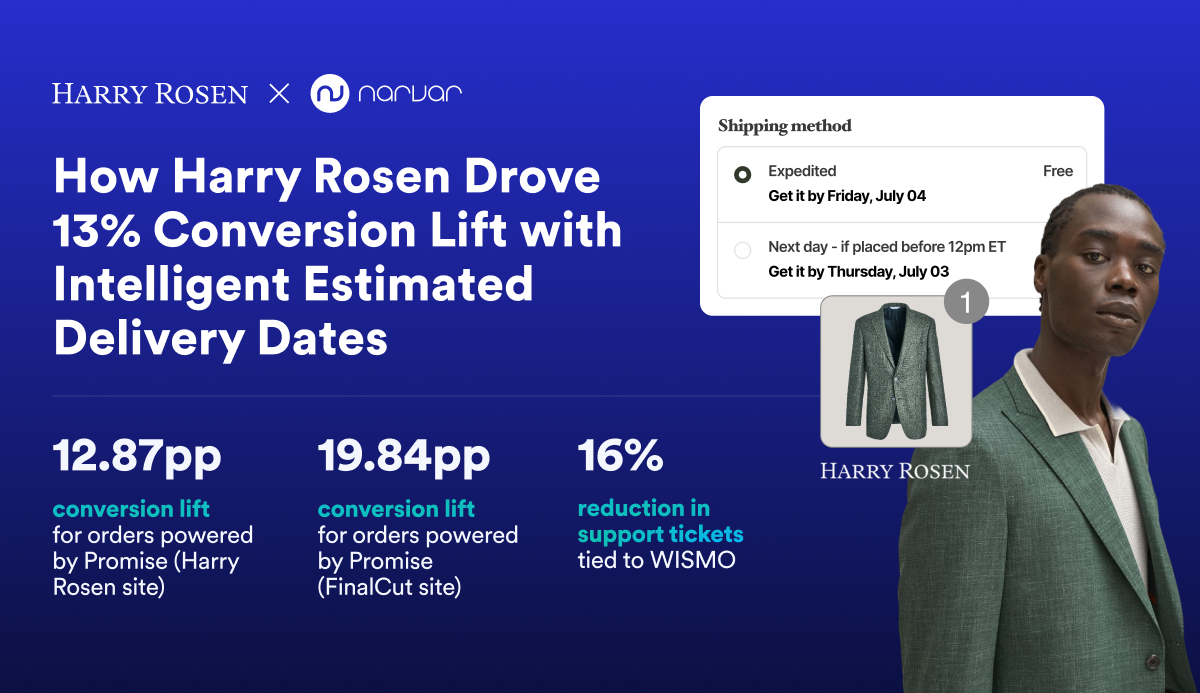
Additionally, given the complexity of fulfillment from stores, internal teams at Harry Rosen value the visibility that Promise offers. Teams can account for existing factors that might impact the EDDs and then make any necessary adjustments to help meet delivery expectations.
“We set a goal of a 90% accuracy rate on delivery timelines as much as possible,” Vanessa said. ”With Promise, we’ve been able to strike the balance of getting that number right.”
With the ability to provide personalized, accurate EDDs rather than static date ranges, Harry Rosen has seen huge improvements in KPIs. And while the vast majority of deliveries have been on time or early, the system also makes it easy for shoppers to reach out for the handful that fall out of range.
“If there’s something off, we're going to hear about it - it’s so easy to do that through a click,” Vanessa said.
Since launching Promise, the Harry Rosen team has seen a 16% reduction in WISMO calls. Although the customer care team still hears from shoppers when there is an issue with a delivery, the highly accurate EDDs have greatly reduced the number of tickets.
Setting new standards for EDDs in retail
No matter what time of year, Harry Rosen’s results make it clear: Implementing Promise is a smart move. It boosts revenue by setting delivery expectations which drives higher checkout conversion. Promise closes the loop, turning first-time buyers into happy shoppers with informed and reliable delivery experiences.
When expectations are met and exceeded, it can create moments of surprise and delight that build lasting trust. For Harry Rosen shoppers, that means turning one-time purchases into ongoing loyalty and brand advocacy.

Shoppers buy more when they know what to expect.
See how an AI-powered EDD can drive higher conversion and boost revenue.

Frequently asked questions (FAQs)
What impact did AI-powered estimated delivery dates (EDDs) have on Harry Rosen's conversions?
Harry Rosen saw a 13 percentage point lift in conversion rates by implementing AI-powered EDDs, leading to more confident customers and higher sales.
Why are estimated delivery dates important for shoppers?
45% of consumers are more likely to buy when they see an estimated delivery date at checkout, and 90% are willing to wait up to three days if they know exactly when their order will arrive.
How did Harry Rosen improve estimated delivery date accuracy with Narvar?
Harry Rosen used Narvar's Promise, an AI-powered solution that predicts accurate estimated delivery dates based on historical and real-time data, improving their delivery accuracy to over 90%.
Related posts



%20(31).webp)
.png)