AI-powered delivery date estimates to boost conversion

Give shoppers peace of mind and protect and grow your bottom line

Personalized tracking experiences to build brand loyalty

Returns and exchanges management to mitigate fraud and reward best customers

Proactive communication to drive customer lifetime value

Delivery claim management to tackle fraud and build trust



How Agentic AI Will Disrupt Post-Purchase Experiences

Autonomous systems hold the key to protecting revenue, margin, and trust.
Key takeaways
- Agentic AI is poised to transform the post-purchase phase of ecommerce, which has become a crucial, complex, and costly part of the retail experience.
- Traditionally, retailers have relied on automation to manage post-purchase tasks, but these systems still require manual intervention.
- Agentic AI offers a shift by autonomously making decisions to optimize business outcomes, including protecting margins, retaining revenue, and reducing operational burdens.
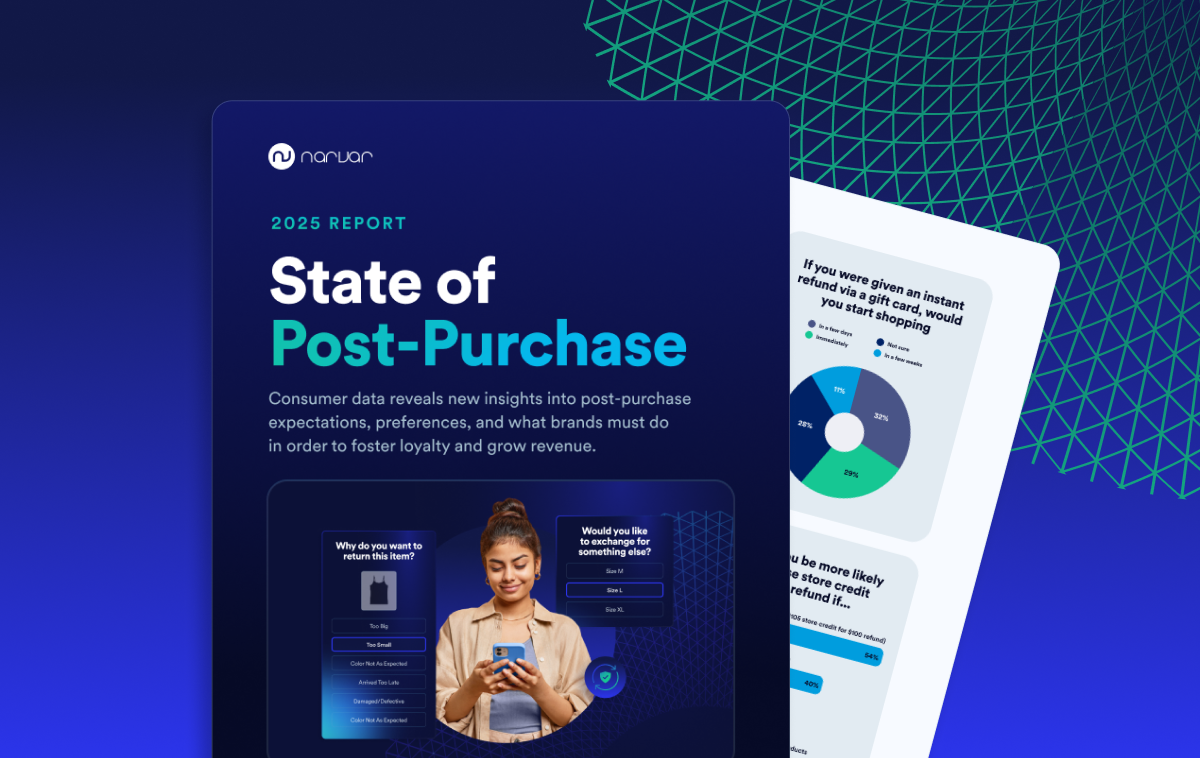

What do shoppers want from the post-purchase experience?
We asked 3,461 consumers where, how, and why they buy. Check out the State of Post-Purchase Report to learn what retailers need to do next.
For years, ecommerce innovation has focused on getting shoppers to buy: better discovery, smarter recommendations, faster checkout, more personalized offers. But the next wave of growth in retail won’t come from convincing shoppers to click Buy Now.
It will come from what happens after checkout.
The post-purchase experience has quietly become one of the most expensive, operationally complex, and loyalty-defining parts of ecommerce. Late deliveries drive support contacts and concessions. Returns erode margins. Exceptions pull teams into endless manual work. And every breakdown after the transaction carries a hidden cost: lost trust that shows up later as lower repeat rates and higher shopper acquisition spend.
Retailers have invested heavily in automation to manage post-purchase complexity — rules engines, alerts, dashboards, and workflows designed to scale operations. That progress matters. But without systems that can continuously interpret context and act, post-purchase will remain dependent on intervention rather than initiative.
Agentic AI changes that model.
Instead of responding to issues after they surface, agentic AI is designed to optimize defined business outcomes — protecting margin, retaining revenue, and reducing operational load — by making decisions and taking action autonomously across complex post-purchase workflows.
That shift makes post-purchase one of the most impactful frontiers for agentic AI in retail.
Why it’s time for post-purchase AI agents
Retail is operating under more pressure than it has in years.
The global ecommerce market continues to grow — projected to reach nearly $7 trillion in 2025 and capture around 20–22% of all retail spend. Yet growth alone isn’t the only story. Online shopping has matured, and with that maturity comes a new set of operational and financial realities that make the post-purchase phase one of the most strategically important parts of the business today.
Margins are thinner. Shopper acquisition costs are climbing. And while consumers have integrated online shopping into their everyday habits, they also expect fast delivery, easy returns, and frictionless resolution of issues when something goes wrong. Delays, errors, and slow refunds don’t just create support tickets — they threaten future revenue: 67% of consumers expect refunds within seven days, and satisfaction drops sharply when it takes longer.
At the same time, return volumes have soared — with ecommerce return rates averaging around 17% and contributing to an estimated $890 billion in return value — creating a multi-billion-dollar drag on profitability and operations.
Post-purchase sits at the center of all these forces — the point where logistics performance meets consumer trust, where fraud risk intersects finance, and where operational decisions have measurable impact on revenue and margin. Every delivery issue, exception, and return forces a trade-off between cost and experience.
Historically, retailers have managed this complexity with rules, thresholds, and manual escalation. That approach worked when post-purchase volume was lower and the operating environment was more predictable. But with today’s high consumer expectations, rising service costs, and economic uncertainty, static rules and human escalation are no longer sufficient.
“With today’s high consumer expectations, rising service costs, and economic uncertainty, static rules and human escalation are no longer sufficient.”
That’s what makes post-purchase uniquely suited to agentic AI.
Agentic systems are designed for environments where decisions must be made continuously, context matters, and outcomes are measurable in real dollars. Rather than optimizing isolated steps in the journey, agentic post-purchase AI manages the entire post-checkout lifecycle — balancing revenue retention, margin protection, and operational efficiency in real time.
In today’s retail landscape, it’s a business imperative. When post-purchase becomes agentic, it stops functioning as a reactive cost center and starts operating like a control system — protecting profitability, scaling operations, and preserving consumer trust even in volatile conditions.
How post-purchase will change with agentic AI
The biggest shift isn’t technological — it’s operational.
Decisions that once required manual review, escalation, or blanket policies are handled continuously and selectively. Actions that used to happen only after a shopper complained now happen earlier — or don’t need to happen at all. And instead of treating every order, return, or exception the same way, agentic post-purchase systems respond in proportion to the risk and opportunity each situation represents.
This is where post-purchase stops absorbing cost and starts protecting value.
Here’s what that looks like in practice.
Delivery management becomes proactive, not reactive
Instead of waiting for a missed delivery promise or a surge of “Where is my order?” contacts, agentic systems continuously assess delivery confidence. When risk increases, they take action — adjusting expectations, initiating interventions, or resolving uncertainty before frustration sets in. The experience shifts from apologizing after the fact to quietly maintaining trust.
Exceptions are resolved with judgment, not blanket rules
Lost packages, stalled shipments, and failed deliveries are inevitable. What changes is how they’re handled. Agentic AI evaluates each exception in context — considering likelihood of recovery, shopper value, and financial exposure — and selects the most appropriate resolution. Some issues are resolved immediately. Others are monitored. Overcorrection becomes the exception, not the default.
Returns become adaptive instead of one-size-fits-all
Rather than applying the same return experience to every shopper and every item, agentic systems assess each return as a decision point. They can encourage exchanges, apply stricter controls when risk is higher, or streamline outcomes when speed matters most. The result is a return experience that protects margin without undermining loyalty.
Shopper communication becomes timely and intentional
Agentic post-purchase doesn’t mean more messages — it means better ones. Communication is triggered by need, not schedules. Shoppers hear from the brand when it matters, with clear context and next steps, instead of generic updates or reactive apologies.
Operational workload shifts from triage to oversight
As agentic systems absorb high-volume decisions, human teams move out of constant firefighting. Instead of manually reviewing every case, teams oversee outcomes, refine guardrails, and focus on the exceptions where human judgment truly adds value. Post-purchase becomes manageable at scale, even as volumes grow.
Together, these changes reshape post-purchase from a series of disconnected reactions into a coordinated system — one that quietly protects revenue, preserves margin, and reinforces trust after checkout.
Protecting ecommerce revenue and retail margins
Delivery issues are one of the fastest ways revenue slips away after checkout. When shoppers lose confidence that an order will arrive as expected, they reach out to support, request compensation, or hesitate to purchase again — even if the order ultimately shows up.
Agentic post-purchase AI reduces this leakage by acting earlier:
- Adjusting delivery expectations before dissatisfaction escalates
- Intervening before refunds or discounts become necessary
- Resolving uncertainty in ways that preserve the original sale
Retailer benefit: Fewer refunds and concessions, higher realized order value
Shopper benefit: Confidence that orders are actively managed without added effort
Revenue is preserved through timely action.
Containing costly post-purchase exceptions without overcorrecting
Lost packages, stalled shipments, and failed deliveries are inevitable at scale. What determines their financial impact is how they’re handled.
Agentic AI evaluates each post-purchase exception in context, weighing recovery likelihood, shopper value, and cost exposure. Instead of defaulting to one-size-fits-all resolutions, the system applies judgment — resolving issues efficiently without unnecessary givebacks.
Retailer benefit: Lower replacement and refund costs, tighter loss control
Shopper benefit: Fair, fast resolutions without friction or escalation
Exceptions become managed costs rather than margin-eroding events.
Turning returns into smarter revenue and margin decisions
Returns represent one of the largest sources of post-purchase margin erosion in ecommerce, yet many retailers still apply rigid policies that ignore context.
Agentic post-purchase systems treat returns as financial decisions, not just operational ones:
- Evaluating shopper history and lifetime value
- Assessing item condition, resale potential, and fraud risk
- Shaping outcomes that favor retention where it makes sense
Instead of defaulting to refunds, these systems encourage exchanges, store credit, or alternative resolutions when they better protect value.
Retailer benefit: Higher retained revenue, reduced fraud, smarter refunding
Shopper benefit: Faster, more relevant return experiences
Returns stop being a tax on growth and start functioning as a loyalty lever.
Preserving shopper loyalty without increasing cost-to-serve
Traditional post-purchase loyalty strategies are expensive. They rely on service gestures, appeasements, and manual intervention — often after frustration has already set in.
Agentic AI scales loyalty differently. By preventing issues early and resolving them selectively, it reduces the need for costly recovery while maintaining trust.
Retailer benefit: Stable repeat purchase rates with lower service costs
Shopper benefit: Fewer problems, fewer apologies, less effort
The most cost-effective loyalty strategy is the one that rarely needs to apologize.
Reducing operational drag across post-purchase operations
Every manual decision after checkout carries opportunity cost. Teams stuck managing post-purchase complexity aren’t optimizing, innovating, or scaling.
Agentic post-purchase AI absorbs that operational burden by autonomously resolving high-volume decisions and escalating only when human judgment truly adds value.
Retailer benefit: Lower operational cost per order, scalable growth
Shopper benefit: Faster outcomes without waiting on humans
Post-purchase stops slowing the business down and starts supporting growth.
“Agentic AI scales loyalty differently. By preventing issues early and resolving them selectively, it reduces the need for costly recovery while maintaining trust.”
Challenges of agentic AI in post-purchase
The upside is significant — but agentic post-purchase doesn’t happen overnight.
Retailers are operating in an environment shaped by years of layered systems, processes, and policies, and those realities don’t disappear simply because decision-making becomes more intelligent. Standing up agentic AI in post-purchase requires navigating a set of very real challenges.
Post-purchase data is often fragmented across logistics providers, customer experience platforms, fraud systems, and financial tools. Without a unified view, even the most advanced AI struggles to apply consistent judgment across the entire post-checkout journey.
There are also understandable concerns around governance and trust. Autonomous systems must operate within clear guardrails, with transparency into why decisions are made and confidence that those decisions align with brand values, consumer expectations, and financial goals.
Just as important is change management. Agentic AI shifts the role of post-purchase teams from reacting to issues toward overseeing intelligent systems. That transition requires new operating models, new skills, and time for teams to build trust in how these systems behave.
Finally, there’s the temptation to move too fast. Full autonomy is compelling, but without strong foundations — data, workflows, guardrails, and measurement — it can introduce more risk than value.
That’s why the goal isn’t instant autonomy. It’s sustainable progress — building agentic capabilities in stages, proving impact along the way, and expanding as confidence grows. When it’s done well, agentic post-purchase feels quiet, controlled, and consistently effective — improving outcomes without disrupting how the business operates.
“The goal isn’t instant autonomy. It’s sustainable progress – building agentic capabilities in stages, proving impact along the way, and expanding as confidence grows.”
How retailers can start the agentic post-purchase journey
Retailers seeing success with agentic AI don’t start by trying to automate everything at once. They take an incremental, outcome-driven approach — focusing first on the decisions that have the greatest impact on revenue, margin, and operational efficiency.
The starting point is clarity. Rather than leading with features or technology, successful teams define the business outcomes they want to improve — whether that’s retaining more revenue after checkout, reducing post-purchase cost-to-serve, or protecting margin in high-risk scenarios.
That clarity also depends on connectivity. Agentic systems require a unified view of post-purchase activity — orders, delivery signals, consumer identity, policies, and historical outcomes — so decisions aren’t made in isolation. When data, rules, and signals live in one place, agentic AI can apply context consistently across the post-checkout journey. This is why retailers with an established post-purchase platform, like Narvar’s, are already well positioned to adopt agentic capabilities.
From there, teams focus on a small set of high-impact post-purchase decisions, such as delivery exceptions, returns handling, or resolution timing. These areas offer clear feedback loops and measurable results, making them well suited for early agentic adoption.
Crucially, guardrails matter more than rigid rules. Agentic systems perform best when they’re given clear boundaries and goals, along with the flexibility to adapt as conditions change. Humans remain in the loop — not to handle every case, but to oversee outcomes, refine parameters, and step in when judgment or empathy is required.
Finally, progress depends on intelligence loops — systems that continuously measure outcomes, learn from decisions, and optimize how actions are taken over time. Agentic systems get better by doing — and by being held accountable to real business results.
When it’s done well, starting the agentic journey feels practical and controlled — delivering measurable gains early while building confidence to expand autonomy responsibly.
Why post-purchase will define the future of agentic AI in retail
Agentic AI is often discussed in abstract terms. In post-purchase, its value is concrete.
This is where retailers decide whether revenue is kept or refunded, whether margins hold or erode, and whether shoppers come back with trust or skepticism. It’s where intelligent systems can quietly prevent loss, preserve relationships, and remove operational friction at scale. Retailers that succeed here will build more resilient, profitable ecommerce businesses.
And while many technology providers will experiment with agentic AI at the edges of commerce, leadership in this next era will require something deeper: real-world scale, domain expertise, and a deep understanding of how post-purchase decisions actually play out.
That’s why post-purchase isn’t just ready for agentic AI. It’s where agentic AI will definitively prove its value.

See How to Intelligently Power Every Moment Beyond Buy
IRISTM empowers retailers to engage consumers, streamline operations, and drive profitable growth through intelligent personalization.

Frequently asked questions (FAQs)
What is the main focus of Agentic AI in post-purchase experiences?
Agentic AI focuses on optimizing business outcomes like protecting margin, retaining revenue, and reducing operational load by making autonomous decisions in post-purchase workflows.
How does Agentic AI handle delivery management?
Agentic AI proactively assesses delivery confidence, adjusts expectations, initiates interventions, and resolves uncertainties before they escalate, maintaining shopper trust.
What are the benefits of Agentic AI for handling returns?
Agentic AI assesses each return based on shopper history, item condition, and fraud risk, encouraging exchanges or store credit to protect margin while maintaining loyalty.
What challenges do retailers face when implementing Agentic AI in post-purchase?
When it comes to implementing agentic AI, retailers need to make sure they don’t move too fast without strong foundations. That means addressing fragmented post-purchase data, governance and trust concerns, and change management issues before getting started.
Related posts