AI-powered delivery date estimates to boost conversion

Give shoppers peace of mind and protect and grow your bottom line

Personalized tracking experiences to build brand loyalty

Returns and exchanges management to mitigate fraud and reward best customers

Proactive communication to drive customer lifetime value

Delivery claim management to tackle fraud and build trust




From Reactive to Agentic: Narvar’s Post-Purchase Predictions for 2026

What’s next for delivery promises, returns, and loyalty as post-purchase becomes autonomous?
Key takeaways
In 2026, agentic AI will reshape retail operations, transforming how brands manage delivery promises, returns, and loyalty. Here are Narvar’s predictions:
- Delivery promises will evolve from static estimates into dynamic decision engines, optimizing for confidence and trust rather than speed.
- Rather than reacting to disruptions, AI systems will proactively manage delivery exceptions to preserve shopper trust.
- Claims decisions will become more contextual, balancing fraud prevention with customer trust instead of relying on rigid rules.
- Return experiences will be tailored to specific business outcomes, whether that's protecting margins, retaining shoppers, or driving exchanges.
- Beyond transactional rewards, AI-powered advocates will act on behalf of shoppers to build deeper loyalty.
- Retailers will differentiate through the integration of shopper data across touchpoints, creating seamless and personalized experiences.
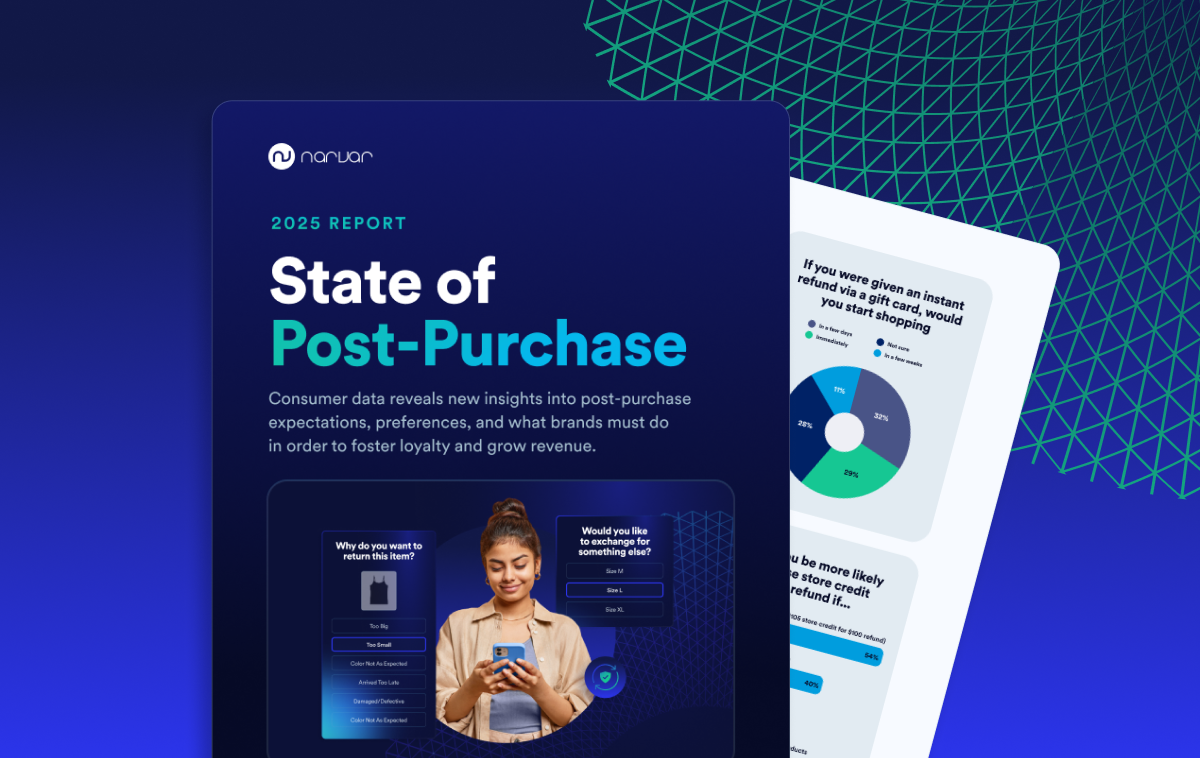

What do shoppers want from the post-purchase experience?
We asked 3,461 consumers where, how, and why they buy. Check out the State of Post-Purchase Report to learn what retailers need to do next.
In ecommerce, the sale has always been the center of attention.
It’s where marketing dollars peak, conversion metrics spike, and executive dashboards light up. But in 2026, the most important decisions in retail will no longer happen at checkout — they’ll happen beyond buy.
That shift didn’t come out of nowhere. Over the last few years, retailers have faced compounding pressure across the post-purchase journey: rising delivery risk, escalating fraud, margin erosion from returns, and shoppers who expect Amazon-level certainty everywhere — without Amazon-level infrastructure.
At the same time, AI has crossed a critical threshold. Large language models made intelligence broadly accessible. But access alone doesn’t create advantage. What’s emerging now — and what will define 2026 — is agentic AI: systems that don’t just analyze information, but decide and act autonomously toward a defined business outcome.
In post-purchase, that changes everything.
Here are Narvar’s predictions for what comes next for the post-purchase experience — and how retailers can get ahead of it.
1. Estimated delivery dates become a decision engine — not a data display
The prediction
By the end of 2026, estimated delivery dates (EDDs) will stop functioning as static facts and start operating as active decision engines. Agentic systems will ask: “Which delivery promise should we make right now — given risk, confidence, and trust?”
Why this will happen
Delivery volatility isn’t going away. Carrier performance varies by region, fulfillment paths change dynamically, and inventory is increasingly distributed across nodes. At the same time, shoppers have learned — often the hard way — that the fastest delivery promise isn’t always the one that arrives on time.
AI already plays a role in improving delivery estimates today. By combining multiple machine learning models — including those trained on carrier performance, fulfillment risk, historical delivery accuracy, and real-time order signals — retailers can assess the likelihood of different delivery outcomes rather than calculating a single optimistic date.
By the end of 2026, these AI-driven assessments will increasingly be orchestrated into decision frameworks that determine which delivery promise to surface, not just how fast it could arrive. Instead of defaulting to the earliest possible date, systems will weigh confidence, risk, and shopper expectations to present the promise most likely to be kept.
What changes for retailers and shoppers
Checkout becomes less about speed optics and more about confidence engineering. Retailers will see fewer downstream exceptions, fewer WISMO contacts, and stronger conversion driven by trust rather than urgency. Shoppers, in turn, gain clarity — not optimism that later turns into frustration.
How retailers can get ahead
- Treat delivery promises as brand commitments, not just dates on a page
- Invest in AI that helps you assess delivery confidence — not just calculate an arrival date
- Evaluate delivery promises based on how well they drive conversion and long-term trust
The brands that win in 2026 won’t be the ones promising the fastest delivery — they’ll be the ones keeping the promise they make.
2. Post-purchase moves from reactive support to proactive exception management
The prediction
In 2026, post-purchase systems will shift from simply monitoring events to proactively managing exceptions before they impact conversion, trust, or repeat purchase.
Why this will happen
The challenge is one of scale. As order volumes grow, so do the number of moments where a delivery delay, misroute, or exception can quietly erode trust. Teams can’t manually keep up, and rigid, rules-based systems struggle when real-world scenarios don’t fit neatly into predefined boxes.
AI already helps retailers detect issues faster. By the end of 2026, those capabilities will increasingly be coordinated into systems that can interpret context and act — intervening early to protect the shopper experience and the revenue attached to it. WISMO agents will reduce unnecessary inbound contact by resolving issues before shoppers ask. Return agents will dynamically adjust flows to retain value when disruptions occur. Escalation becomes the exception — not because problems disappear, but because fewer of them become consumer-facing.
This aligns with broader enterprise AI trends. As McKinsey notes, the next wave of value comes not just from insight, but from systems that can execute decisions in real time — especially in high-volume, consumer-facing environments.
What changes for retailers and shoppers
For retailers, proactive exception management becomes a growth lever. Fewer disrupted deliveries mean fewer abandoned repeat purchases, lower support costs, and stronger lifetime value — without adding friction at checkout or in post-purchase flows.
For shoppers, the experience feels calmer and more reliable. Issues are handled before they require effort, and when intervention is visible, it feels intentional rather than apologetic. Post-purchase stops being a moment of uncertainty and becomes a reinforcing signal that the brand is dependable.
How retailers can get ahead
- Design post-purchase workflows around protecting conversion, retention, and lifetime value — not just resolving tickets
- Enable AI-powered systems to take action within clear guardrails, not simply flag issues for review
- Treat escalation as a signal of last resort, not the primary mechanism for handling exceptions
In 2026, the strongest post-purchase experiences will quietly protect revenue and loyalty by preventing small disruptions from becoming reasons shoppers don’t come back.
3. Claims decisions shift from rigid rules to adaptive decisioning
The prediction
By the end of 2026, claims decisions will no longer be governed by rigid thresholds and blanket policies. Instead, agentic AI will evaluate claims through contextual judgment. The core question won’t be, “Does this break a rule?” It will be, “What resolution protects margin without breaking trust?”
Why this will happen
Fraud has grown more sophisticated — and so have legitimate shoppers. Static rules fail both sides: They punish good shoppers while still leaking revenue to bad actors.
Agentic systems can evaluate claims holistically, factoring in shopper history, real-time delivery data, item attributes, and behavioral signals. That allows systems to determine which claims can be approved instantly, which require verification, and which should be denied — along with how to communicate that decision clearly.
Narvar data already shows that blanket fraud controls often backfire, increasing churn among high-value shoppers.
What changes for retailers and shoppers
Retailers move from all-or-nothing fraud controls to precision margin protection. Shoppers experience fairness instead of friction. Trust becomes something the system actively preserves — not something policies accidentally destroy.
How retailers can get ahead
- Replace hard thresholds with probabilistic, context-aware models
- Treat explanation as part of the resolution, not an afterthought
- Align fraud strategy with lifetime value — not single-order economics
In 2026, fraud prevention is about precision — stopping bad actors without punishing good shoppers.
4. Returns become optimized journeys
The prediction
By 2026, returns will no longer be treated as static, one-size-fits-all flows. They’ll become outcome-driven journeys, shaped dynamically based on retailer-defined priorities.
Before a return is finalized, systems will be able to guide shoppers toward different paths — such as exchanges, store credit, or refunds. This will be based on the outcomes a retailer is trying to achieve in that moment, whether that’s protecting margin, retaining the shopper, clearing inventory, or reducing operational cost.
Why this will happen
Returns are one of retail’s most expensive and complex post-purchase moments — but they’re also one of the few interactions that happen after a shopper has already chosen a brand. Treating every return the same ignores both shopper intent and retailer strategy.
AI-enabled return systems already allow retailers to offer multiple resolution options. By the end of 2026, those capabilities will increasingly be coordinated into smarter return flows that adapt based on context: who the shopper is, what they’re returning, and what the business is optimizing for at that point in time.
Rather than enforcing a single “best” outcome, systems will help retailers operationalize their return strategy — applying different paths and incentives based on clearly defined goals.
This reflects broader shifts in retail economics, where improving retention and lifetime value often delivers more impact than acquisition alone — but only when retailers can choose how and where to apply that leverage.
What changes for retailers and shoppers
For retailers, returns become a lever — not just a cost. Instead of defaulting to refunds, they gain more control over how returns affect margin, inventory, and long-term shopper relationships.
For shoppers, returns feel more intentional and relevant. They’re presented with options that make sense for their situation, without added friction or unnecessary hoops. The experience remains convenient, but no longer generic.
How retailers can get ahead
- Design return flows around clear business objectives, which may vary by brand, category, or shopper segment
- Personalize return options and incentives based on shopper behavior, item type, and operational context
- Treat returns as a configurable decision point — not a fixed process — that can evolve as priorities change
In 2026, the most effective retailers will use returns deliberately, in ways that support both the business and the shopper relationship.
5. Loyalty moves from rewards to representation
The prediction
By 2026, loyalty in post-purchase will no longer be driven primarily by points, perks, or promotions. It will be built by how effectively an intelligent system represents the shopper’s interests after the sale.
Why this will happen
Today’s loyalty programs are transactional. They reward behavior, but they don’t advocate for the shopper when something goes wrong.
Agentic AI changes that dynamic. Systems will act continuously on the shopper’s behalf, deciding when to intervene, which outcome is most equitable, and how to resolve issues in ways that preserve long-term trust.
This shift from reactive service to autonomous advocacy is subtle but powerful.
What changes for retailers and shoppers
Loyalty becomes experiential rather than programmatic. Our research shows that post-purchase experiences have an outsized impact on repeat purchase behavior. So shoppers don’t “earn” goodwill — they feel protected by it. Retailers build relationships that compound instead of reset with each transaction.
How retailers can get ahead
- Measure loyalty using post-purchase signals — like repeat purchases, reduced support contact, and acceptance of alternative resolutions — not just points redemption
- Empower systems to act in the shopper’s best interest within guardrails
- Design post-purchase experiences that feel intentional, not procedural
In 2026, loyalty won’t be a program. It will be a behavior.
6. Proprietary data becomes the defining advantage
The prediction
If 2025 was about efficiency gains from public LLMs, 2026 will be about competitive advantage powered by proprietary data. Agentic experiences will be differentiated not by model access but by the depth, quality, and continuity of a retailer’s own data.
Why this will happen
As AI-powered experiences become more common, basic interactions will start to feel the same everywhere. What will set brands apart is whether shoppers can move seamlessly between a website, an app, email, and AI-powered tools without having to start over each time.
Retailers that unify shopper behavior, preferences, and history into a single intelligence layer will deliver experiences that feel personal everywhere. Those that don’t will feel fragmented — even if the UI looks modern.
What changes for retailers and shoppers
Shoppers experience a seamless journey across touchpoints — and the data that enables that experience becomes a powerful source of differentiation for retailers.
How retailers can get ahead
- Invest in data infrastructure before interface experimentation
- Treat AI as an execution layer, not the source of differentiation
- Design experiences that persist rather than reset across channels
In 2026, the brands that win will own the intelligence behind their AI.
The road ahead
By the end of 2026, post-purchase will be governed by agentic AI that can evaluate context, make decisions, and act autonomously to protect trust, margin, and loyalty at scale.
This shift won’t happen all at once, but it will be decisive. Retailers that prepare now will turn post-purchase into a strategic advantage. Those that don’t will find themselves reacting to problems their competitors are already preventing.

See How to Intelligently Power Every Moment Beyond Buy
IRISTM empowers retailers to engage consumers, streamline operations, and drive profitable growth through intelligent personalization.

Frequently asked questions (FAQs)
What will be the role of estimated delivery dates in 2026?
By 2026, estimated delivery dates will act as decision engines, using AI to determine the best delivery promise based on risk, confidence, and trust, rather than just displaying static data.
How will post-purchase systems evolve in 2026?
Post-purchase systems will shift from reactive support to proactive exception management, using AI to handle issues before they impact conversion, trust, or repeat purchases.
What changes are expected in retail claims decisions in 2026?
Claims decisions will move from rigid rules to adaptive decisioning, with AI evaluating claims contextually to protect margins and maintain shopper trust.
How will returns be managed differently in 2026?
Returns will become optimized journeys, dynamically shaped by AI based on retailer priorities, offering multiple resolution options to protect margins and retain shoppers.
Related posts
.png)