AI-powered delivery date estimates to boost conversion

Give shoppers peace of mind and protect and grow your bottom line

Personalized tracking experiences to build brand loyalty

Returns and exchanges management to mitigate fraud and reward best customers

Proactive communication to drive customer lifetime value

Delivery claim management to tackle fraud and build trust





All the Better to Trick You With: Fraudsters are Passing as VIP Consumers

Who’s afraid of the Big Bad Wolf? Not the retailers using artificial intelligence to identify and prevent post-purchase fraud.
Key takeaways
- Fraud is pervasive and costly, with 98% of merchants experiencing fraud and 15% of returns ($103B) identified as fraudulent.
- Fraudsters increasingly mimic high-value customers, making them nearly indistinguishable from legitimate VIP shoppers based on traditional signals.
- High activity doesn’t equal high trust, as frequent fraudsters often shop, return, and engage more than typical loyal customers.
- Traditional fraud controls create a lose-lose scenario, forcing retailers to choose between margin protection and customer experience.
- AI-powered intelligence enables precision, allowing retailers to stop fraud while preserving seamless, low-friction experiences for trusted shoppers.
Once upon a time, there was a retailer who just wanted to delight their shoppers. They offered fast shipping, generous perks, and a wide-open return policy.
One day, they delivered to what they thought was a loyal consumer’s door…
But instead of Grandma, it was the Big Bad (ahem, Fraudulent) Wolf, dressed head-to-toe like a high-value shopper. Platinum-tier status. Sky-high AOV. Perfect purchase history.
Not a single red flag in sight — all the better to trick you with.
In today’s ecommerce tale, fraudsters aren’t lurking in the shadows — they’re sitting comfortably in your CRM. They look like your most loyal consumers. They act like your most profitable shoppers. And without the right intelligence, they’re nearly impossible to spot until it’s too late.
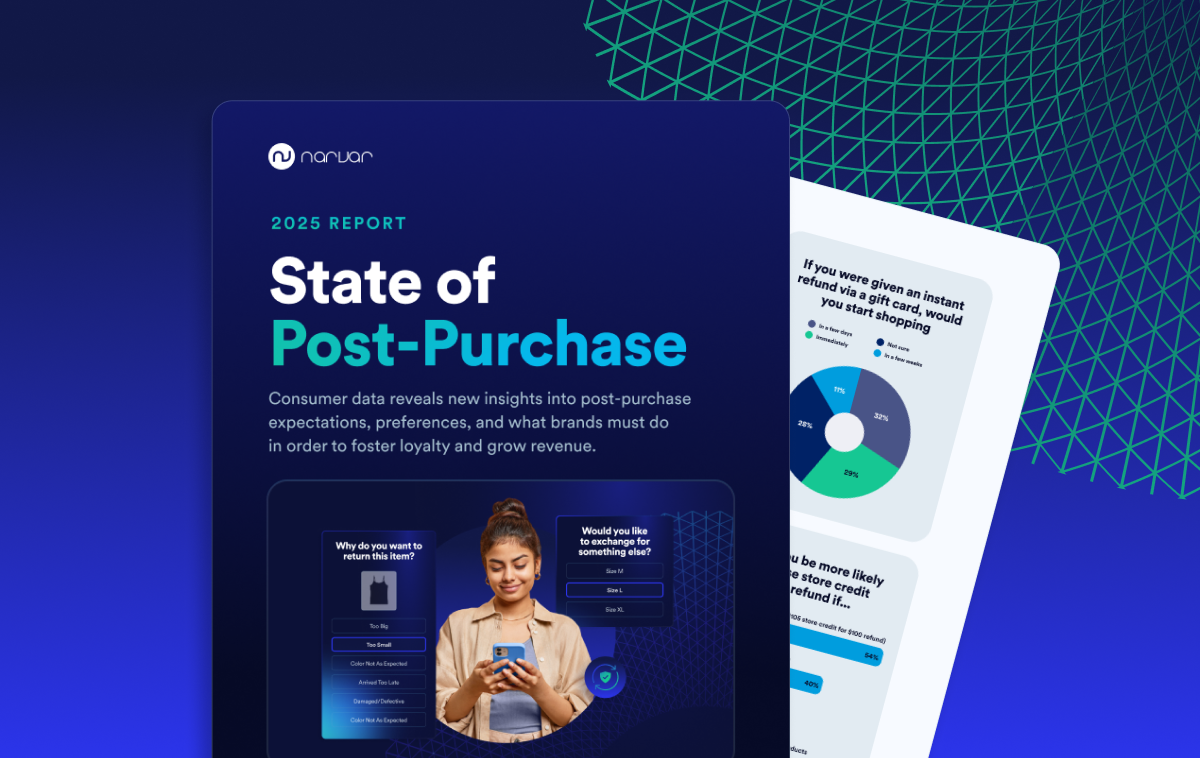
Want to know what else is hiding under the post-purchase hood?
Download the 2025 State of Post-Purchase Report for fresh data on post-purchase fraud and what consumers want from their retail experiences.
My, what big claims you have!
Fraud is eroding retail margins at an astounding rate. In the past 12 months, 98% of merchants experienced at least one type of fraud. And in 2024 alone, 15% of all returns — totaling $103 billion — were fraudulent.
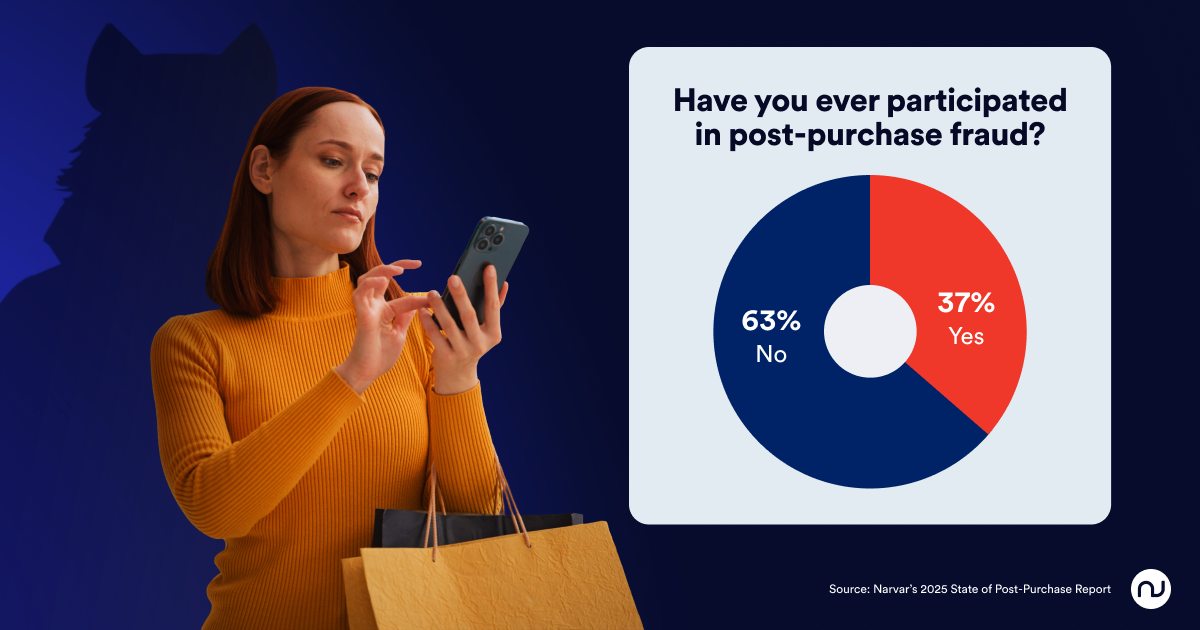
We surveyed 3,461 U.S. consumers in our 2025 State of Post-Purchase Report, and found that more than one in three consumers (37%) admitted to committing some form of retail fraud or abuse at least once in their lifetime.
Unfortunately, the wolf’s in VIP clothing
Retailers are struggling to differentiate high-trust consumers from bad actors. (Read: they can't tell grandma from the Big Bad Wolf).
And the challenge is bigger than it appears: Frequent fraudsters (the ones that admit to engaging in these types of activities at least once a month) mirror the behavior and profile of top-spending shoppers (spending more than $5,000 online annually) so closely that they’re nearly indistinguishable at purchase.
While frequent fraudsters are slightly more likely to be male, the demographic differences stop there. In fact, many of the signals retailers typically rely on don’t separate the two groups at all. Frequent fraudsters, for example, are more likely to say they have extra cash for unplanned purchases — 89% report having discretionary funds available, compared with just 69% of shoppers who spend more than $5,000 annually online.
But that financial flexibility doesn’t map to income. Our survey found that both groups cluster around similar income levels, with 47% of frequent fraudsters and 50% of high-spend shoppers earning under $100,000 a year. Household makeup tells a similarly confusing story: just 14% of frequent fraudsters live in child-free homes, while 45% of high-spend shoppers do — a contrast that offers no reliable pattern for risk.
The takeaway is clear: On paper, fraudsters look like VIPs. Their habits, their spending behavior, and their life circumstances don’t raise obvious alarms, which is why far too many slip through undetected.
The wolf has a penchant for online shopping
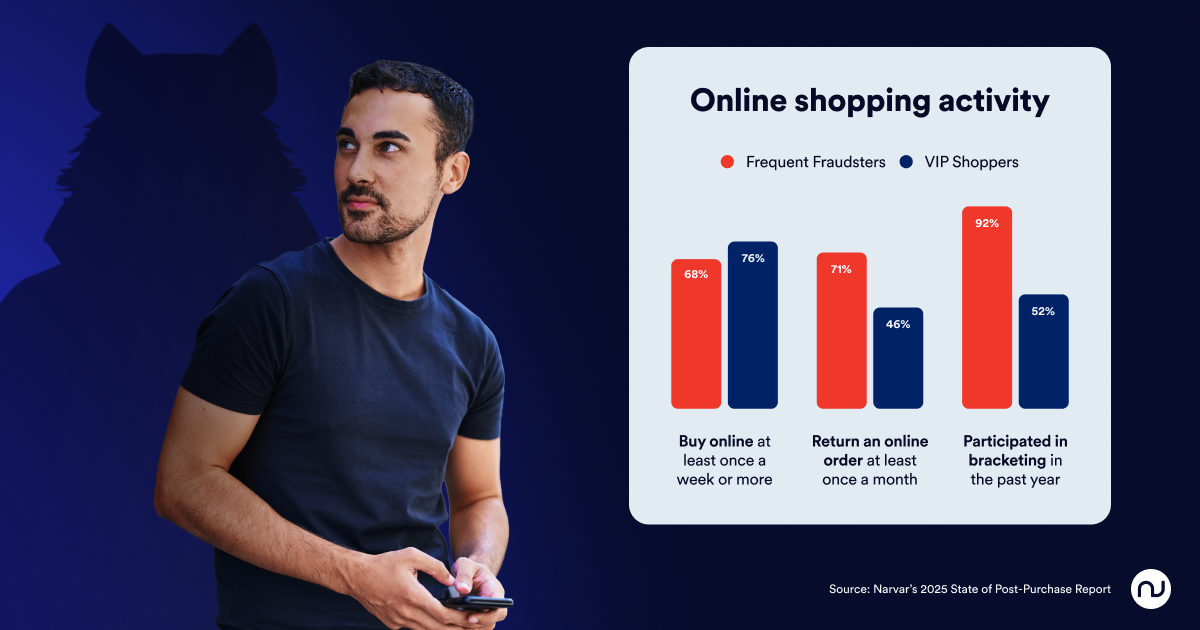
Fraudsters aren’t casual opportunists. They’re highly fluent ecommerce shoppers. On the surface, they behave just like your most valuable customers, sometimes even more so. For example, 68% buy online at least once a week, and 71% return an online order monthly. Nearly all of them (92%) engaged in bracketing this year. Those numbers often exceed the post-purchase habits of legitimate high-spend shoppers.
In other words, fraudsters don’t stand out because they shop less. They blend in because they shop a lot. Their activity makes them look engaged, loyal, and profitable — exactly the kind of behavior retailers hesitate to disrupt.
And that’s the core tension: What if that high activity is genuine? Without the right intelligence, retailers risk penalizing true VIPs while the wolf slips by unnoticed.
How retailers missed the forest for the trees
Traditional fraud review was like a game of hide-and-seek that retailers could never win. Manual audits, gut checks, and inconsistent review processes left plenty of room for wolves to slip by.
In fact, some retailers report spending up to $70 to investigate a single claim. That’s not fraud prevention. It’s margin erosion dressed up as due diligence.
And the fallout was predictable: High-trust shoppers got caught in the crossfire. Without reliable signals to tell good actors from bad, retailers resorted to blanket rules, such as tighter return windows, more friction, and extra verification steps that slowed down everyone, even the loyal customers who’d done nothing wrong.
Retailers often had to choose: punish high-trust consumers with rigid policies or lose money to fraudsters exploiting lenient ones.
As Anisa Kumar, CEO of Narvar, puts it:
“The danger is that retailers end up punishing their best shoppers with rigid policies in an effort to stop abuse. It often reflects a lack of awareness that fraud drives up costs, forces stricter policies, and ultimately makes shopping harder and more expensive for everyone.”
When retailers can’t spot fraudulent behavior, both the customer experience and the bottom line take the hit.
AI: All the better to see you with
By processing billions of consumer interactions and transaction data points, AI models can detect suspicious behavior in real time and flag potentially fraudulent delivery and return claims before they impact margins.
These systems distinguish between high-trust consumers and likely fraudsters at the moment a claim is made, allowing retailers to tailor the experience accordingly. For example, retailers can use AI to proactively prevent fraudulent returns by enforcing eligibility rules, identifying repeat abuse patterns, and dynamically adjusting return policies (such as shorter windows or limited returns) for risky shoppers.
At the same time, AI can enhance the experience for trusted shoppers — enabling faster refunds, instant credits at first scan, seamless exchanges, or even keep-the-item options.
The result is a more balanced approach: Fraud is stopped before it damages the bottom line, while loyal shoppers continue to enjoy the flexible, hassle-free return experiences they expect.
Pulling back the hood: How AI spots the Big Bad Wolf
Take Narvar’s Intelligent Retail Insights Service (IRIS™), for example. IRIS™ is the AI engine powering Narvar’s post-purchase platform, purpose-built to help retailers stop fraud before it starts.
Trained on more than 74 billion+ consumer interactions annually, IRIS™ detects the subtle signals that separate legitimate VIPs from opportunistic fraudsters — even when they look nearly identical on the surface.
By continuously learning from post-purchase behavior across the industry, IRIS™ helps brands make smarter, more personalized decisions at scale, protecting margins, preserving customer trust, and turning every touchpoint into a strategic advantage.
Happily ever after starts with personalized intelligence
The moral of today’s retail fairytale? You don’t beat the Big Bad Wolf by locking every door. You outsmart him by knowing exactly who’s knocking. With intelligent, real-time insight, every shopper gets a personalized experience that helps retailers grow — and protect — revenue.

Ready to spot the Big Bad Wolf in your delivery and returns claims?
Discover how Narvar’s IRIS™ uses AI and real-time intelligence to distinguish VIPs from fraudsters — no cloak and dagger required.

Frequently asked questions (FAQs)
What is retail fraud?
Retail fraud refers to any deceptive activity that results in financial loss for a retailer, including return abuse, false claims, payment fraud, and account misuse.
How common is retail fraud?
Retail fraud is widespread, with most merchants experiencing some form of fraud each year. In 2024 alone, for example, 15% of all returns — totaling $103 billion — were fraudulent.
What is “friendly fraud” in ecommerce?
Friendly fraud occurs when a legitimate customer abuses policies or falsely claims an issue (such as “item not received”) to receive a refund or replacement.
Why is return fraud difficult to detect?
Return fraud is difficult to detect because fraudulent behavior often mirrors legitimate customer activity. High-frequency shoppers and fraudsters can look nearly identical without deeper behavioral insights.
How does ecommerce fraud impact retailers?
Ecommerce fraud erodes profit margins, increases operational costs, and forces retailers to implement stricter policies that can negatively impact the customer experience.
What are examples of retail fraud?
Common examples of retail fraud include false “delivered, not received” claims, returning worn or used items, bracketing (buying multiple items with the intent to return most), account takeovers, and payment fraud.
How can retailers prevent fraud without hurting customer experience?
Retailers can use AI and data-driven insights to identify high-risk behavior and apply targeted controls, while maintaining fast, frictionless experiences for trusted customers.
What role does AI play in preventing ecommerce fraud?
AI helps retailers detect patterns, identify suspicious behavior in real time, and differentiate between legitimate shoppers and bad actors — enabling smarter, more personalized fraud prevention.
Why shouldn’t retailers rely on blanket fraud policies?
Blanket policies (like stricter return windows or heavy verification) can frustrate loyal customers and reduce conversion. More precise, intelligence-driven approaches protect both margins and experience.
Related posts
.png)